mErCS and jecs
How mErCS differs from jecs 0.11: the design, the behaviour, the numbers, and how to move code over.
Contents
Design
An archetype ECS (jecs, flecs) stores the entities with the same set of components together. That makes iteration fast, but every add or remove moves the entity to another archetype and copies all its columns, every new combination of components creates an archetype that lives until someone cleans it up, and relationships to many targets create an archetype per target.
mErCS keeps, for every component, tag or pair, a bitset of the entities that have it, and the values in pages indexed by the entity slot (the model of the C# library StaticEcs, adapted to Luau). A query ANDs the bitsets 32 entities at a time and walks the set bits.
| jecs 0.11 | mErCS | |
|---|---|---|
| add / remove a component | moves the entity, copies all its columns: O(components) | sets a bit and a value: O(1) |
| new combination of components | creates an archetype (kept until world:cleanup()) | nothing to create |
| pair with many targets | an archetype per target | one small record per pair, freed with its target |
| components per world | 256 via world:component() | no limit |
ids per get / has call | 4 | 8, any number with get_list / has_all |
| memory per entity with 4 components | 320 B | 130 B |
| deep hierarchies | the cascade recurses: stack overflow at about 6000 levels | any depth (past 100 levels the rest is queued) |
Compatibility
The API follows jecs: worlds, entities, components, tags, pairs, wildcards, Exclusive,
cleanup policies, hooks, signals, Name, pre-registration (jecs.component() /
jecs.tag() / jecs.meta()), the ECS_* helpers and the builtin ids.
The jecs test suite (test/jecs_compat/) runs against this library: 125 of 125 applicable
cases pass (its bulk_insert / bulk_remove come from a test shim, as loops of set /
remove). The cases that inspect jecs internals (archetype records, edges, the entity
visualiser) are not applicable and are listed in test/jecs_compat/README.md.
Differences in behaviour
- No archetypes:
world:cleanup(),query:fini()and the idsArchetypeCreate/ArchetypeDeletedo not exist (there is nothing for them to do), hooks do not get anoldarchetypeargument. - The jecs helpers
World.new,w,bulk_insert/bulk_remove,new/new_w_id/new_low_id,query:iter()andis_tagare not provided: they would only repeat native calls (see Migrating from jecs). - jecs internals (
query:archetypes(),world.entity_index,entity_index_try_get) are not provided either; the jabby adapter gives the debugger what it reads. - An uncached query can be iterated again (jecs drains it after the first loop).
get/hastake up to 8 ids positionally (jecs: 4).- The iteration order is ascending by entity slot, not by archetype.
- Builtin ids after
Namehave other numbers:Exclusiveis 268 (jecs: 270),Disabled(not in jecs) 269,Rest270 (jecs: 271). - The jecs observer addon (
modules/OB) depends on archetypes and does not work; use hooks, signals or change tracking. - Setting a hook after connecting signals keeps the signals (in jecs the hook replaces them),
and
world:get(id, ecs.OnAdd)returns the hook, not the signal dispatcher. - A signal listener that disconnects itself while it runs does not make the next listener miss the event (in jecs it does).
- Changing the world during a loop: the current entity may be changed or deleted in both. jecs may visit an entity twice when others are removed from its archetype; here an entity deleted ahead of the loop may be returned once as a dead id with nil values.
Beyond jecs
query:each(fn)— a callback per match, 30–60 % faster than the for-in loop.query:any(...)— OR terms.- Batch operations:
query:count,add_all,set_all,remove_all,delete_all, andworld:remove_all(id). - Change tracking by ticks:
world:track,world:tick, the:added/:changed/:removedfilters. ecs.Disabled: entities hidden from queries without removing their components.world:ids(e), a debug world (ecs.world(true)),query:spans()withworld:column(id).
Performance
Benchmarks in bench/ with luau 0.703. The jecs numbers were measured with the fork
dubalda/jecs at commit 082ec88, which differs from the Wally release 0.11.0 now used by
the repository only by world:targets. Ratio = mErCS / jecs time (lower is better);
interpreter (-O2, the Roblox client) / native (-O2 --codegen, the Roblox server).
Roblox Studio: Benchmarker shows the same comparison inside
Roblox Studio.
A synthetic game frame
bench/frame.luau: 3000 units with 2 attachments each follow their parents, 60 projectiles
spawn and expire per frame, damage uses a one-frame tag, 5 % of the units switch AI state
tags; plain for-in loops, the same code for both libraries. Median frame time; the queries
are written inline in every frame, or created once and :cached() (the recommended jecs
style):
| jecs | mErCS | ratio | |
|---|---|---|---|
| interpreter, inline queries | 5.22 ms | 2.46 ms | 0.47× |
| interpreter, cached queries | 4.95 ms | 2.41 ms | 0.49× |
| native, inline queries | 4.58 ms | 1.62 ms | 0.35× |
| native, cached queries | 4.29 ms | 1.67 ms | 0.39× |
A long session
bench/leak.luau: 5 of 200 enemies die and respawn every frame, 10 % of 500 units retarget
a living enemy through a pair (Targeting, enemy) and switch a state tag; interpreter. Heap
growth since the start and time per frame:
| frame | jecs | jecs + world:cleanup() every 600 frames | mErCS |
|---|---|---|---|
| 1000 | +3.6 MB, 0.19 ms | +3.6 MB, 0.20 ms | +0.4 MB, 0.08 ms |
| 3000 | +9.0 MB, 0.22 ms | +8.8 MB, 0.22 ms | +0.4 MB, 0.08 ms |
| 5000 | +15.4 MB, 0.22 ms | +15.7 MB, 0.23 ms | +0.4 MB, 0.08 ms |
The archetypes of dead targets stay in jecs (cleanup does not release them all); here nothing accumulates.
Single operations
bench/run.luau, 131 072 entities, minimum of 7 runs; ratios within ±10 % of 1.0 vary
between runs:
| Scenario | jecs, ns (interp. / native) | ratio (interp. / native) |
|---|---|---|
| create an entity | 180 / 159 | 0.20× / 0.15× |
| delete an entity with 4 components | 363 / 362 | 0.99× / 0.56× |
| add a first component / set an existing one / remove | 124 / 100, 66 / 53, 179 / 162 | 1.13× / 0.84×, 0.94× / 0.79×, 0.60× / 0.35× |
| add or remove when the entity has 5…40 components | 351…2730 / 297…2250 | 0.35…0.04× / 0.23…0.02× |
| tag add / remove / toggle on 10 % of entities per frame | 316 / 265, 323 / 290, 969 / 602 | 0.28× / 0.20×, 0.32× / 0.21×, 0.16× / 0.16× |
get 1 / 2 / 4 ids | 58 / 54, 67 / 57, 82 / 64 | 0.81× / 0.70×, 0.90× / 0.70×, 1.02× / 0.79× |
has 1 / 4 ids | 59 / 34, 68 / 43 | 0.81× / 0.87×, 1.24× / 0.93× |
pair add / set an existing value / remove / target | 274 / 193, 76 / 65, 234 / 206, 165 / 147 | 0.87× / 0.72×, 0.94× / 0.72×, 0.75× / 0.45×, 0.41× / 0.33× |
delete a target (1000 × 100 sources) / ChildOf cascade (per child) | 180 / 178, 294 / 301 | 0.70× / 0.39×, 1.04× / 0.67× |
| for-in, 4 values, per entity: 8192 / 16 / 1 entities per archetype | 44 / 34, 66 / 56, 246 / 155 | 1.06× / 0.96×, 0.99× / 0.67×, 0.28× / 0.27× |
query:each, same worlds, against the jecs for-in | 44 / 34, 66 / 56, 246 / 155 | 0.68× / 0.47×, 0.65× / 0.47×, 0.19× / 0.16× |
manual loop (spans / jecs archetypes): 8192 / 16 per archetype | 12 / 5, 46 / 30 | 1.08× / 1.10×, 0.58× / 0.32× |
for-in with without (half excluded) / sparse match (1 %) | 32 / 28, 39 / 34 | 1.06× / 1.12×, 1.5–1.6× / 1.52× |
query:each for the same, against the jecs for-in | 32 / 28, 39 / 34 | 0.61× / 0.42×, 0.92× / 0.82× |
| a small query created on every call (15 matches of 1000 entities) | 1230 / 1080 | 1.00× / 1.00× |
| query with 10 terms | 92 / 66 | 0.95× / 0.89× |
| first iteration of a new query with 2000 archetypes | 106 000 / 103 000 | 0.004× / 0.003× |
| spawn + despawn (10 components, 2 tags) / hierarchy of 1 + 5 | 3980 / 3690, 19 800 / 18 500 | 0.55× / 0.34×, 0.47× / 0.37× |
| per match of a query (half of the entities): add a tag / set a component / remove a component (batch operations against a jecs collect-and-change loop) | 278 / 257, 287 / 246, 276 / 261 | 0.10× / 0.04×, 0.21× / 0.08×, 0.12× / 0.04× |
| the same: delete the matches / count them | 434 / 406, 31 / 28 | 0.89× / 0.59×, 0.20× / 0.09× |
Memory and garbage
Bytes kept per unit (mErCS vs jecs, the same in both modes): an empty entity 32 vs
240; an entity with 4 components 130 vs 320; with 10 components and 5 tags 234 vs 417; a
ChildOf child 456 vs 726; a unique tag per entity 945 vs 1630; 1000 components on 100
entities each, per add 162 vs 398; growth per hierarchy spawn/despawn cycle 0 vs 218.
Garbage per iteration of a 2-component query over 200 entities: an inline
for ... in world:query(A, B) allocates an 82-byte handle (jecs: 922 bytes); a stored query
allocates nothing (jecs cached: nothing).
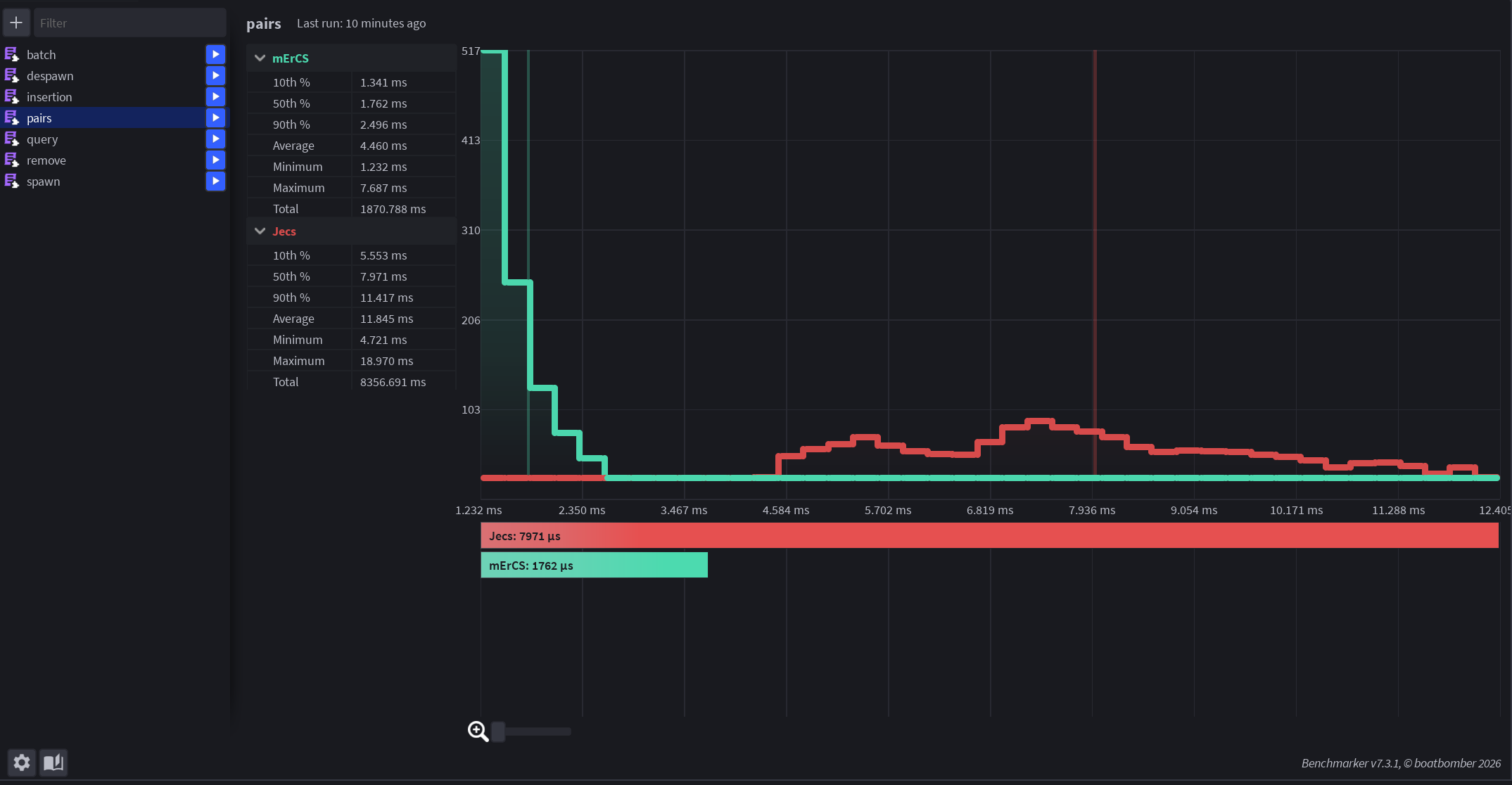
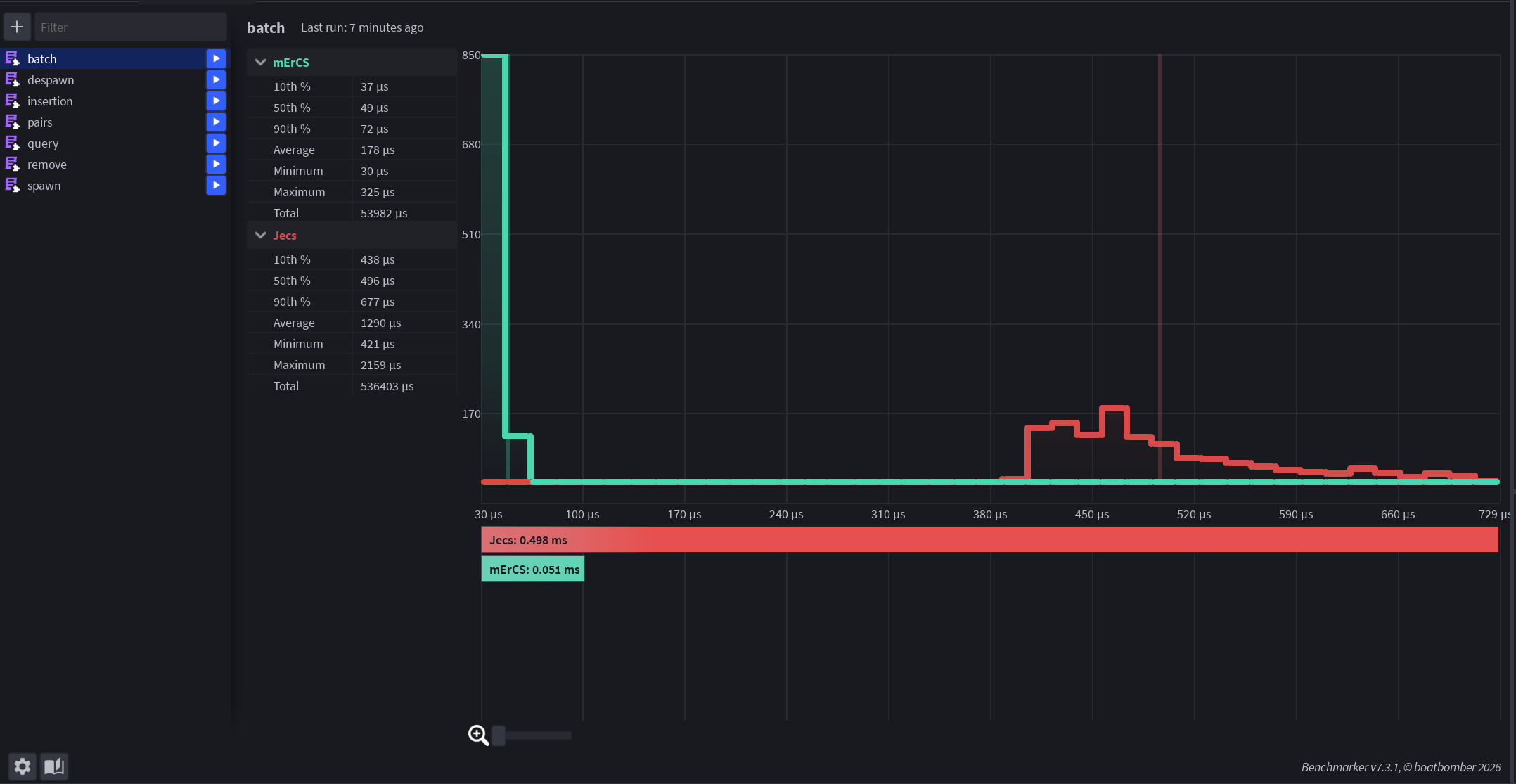
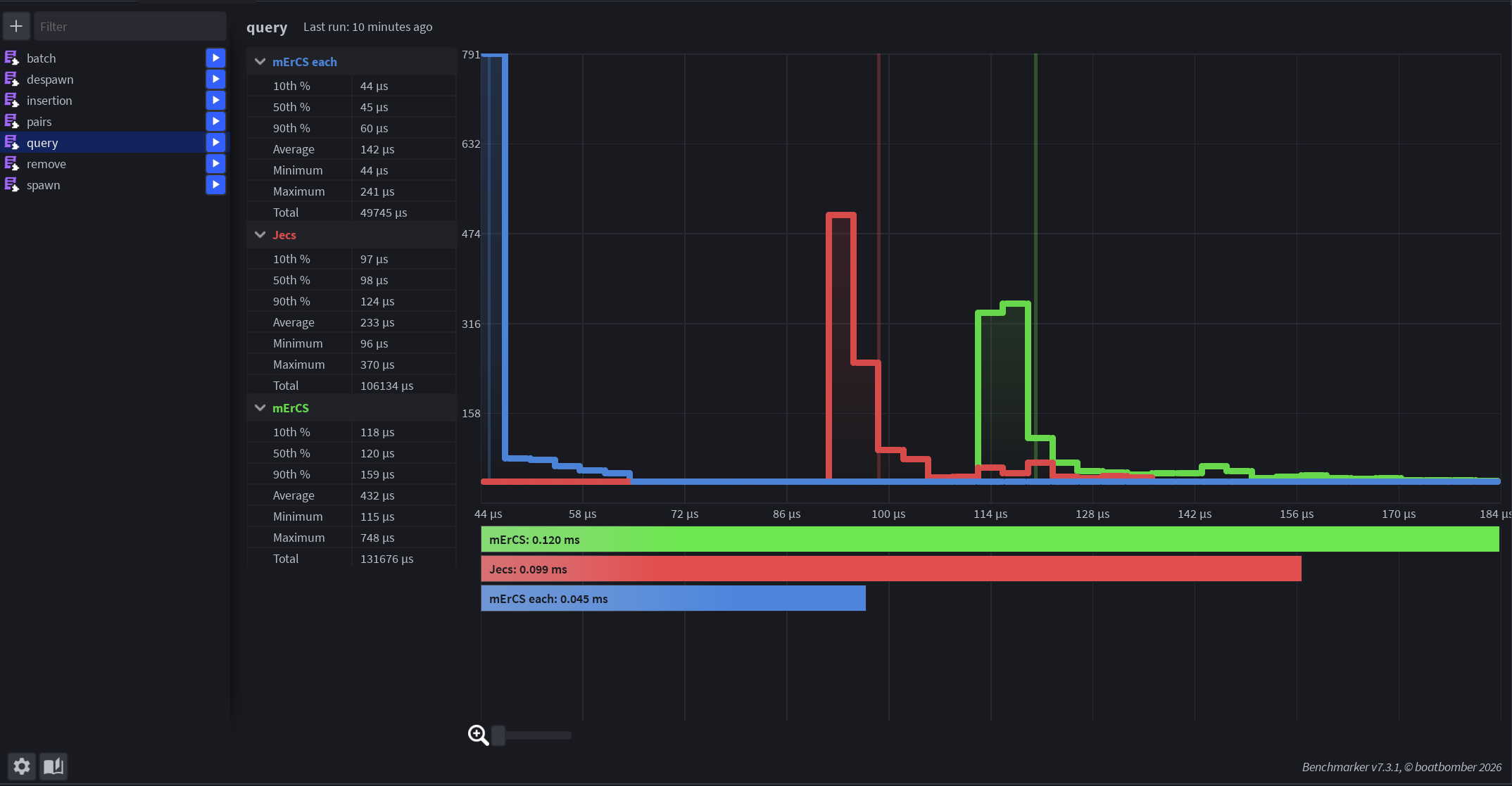
Roblox Studio: Benchmarker
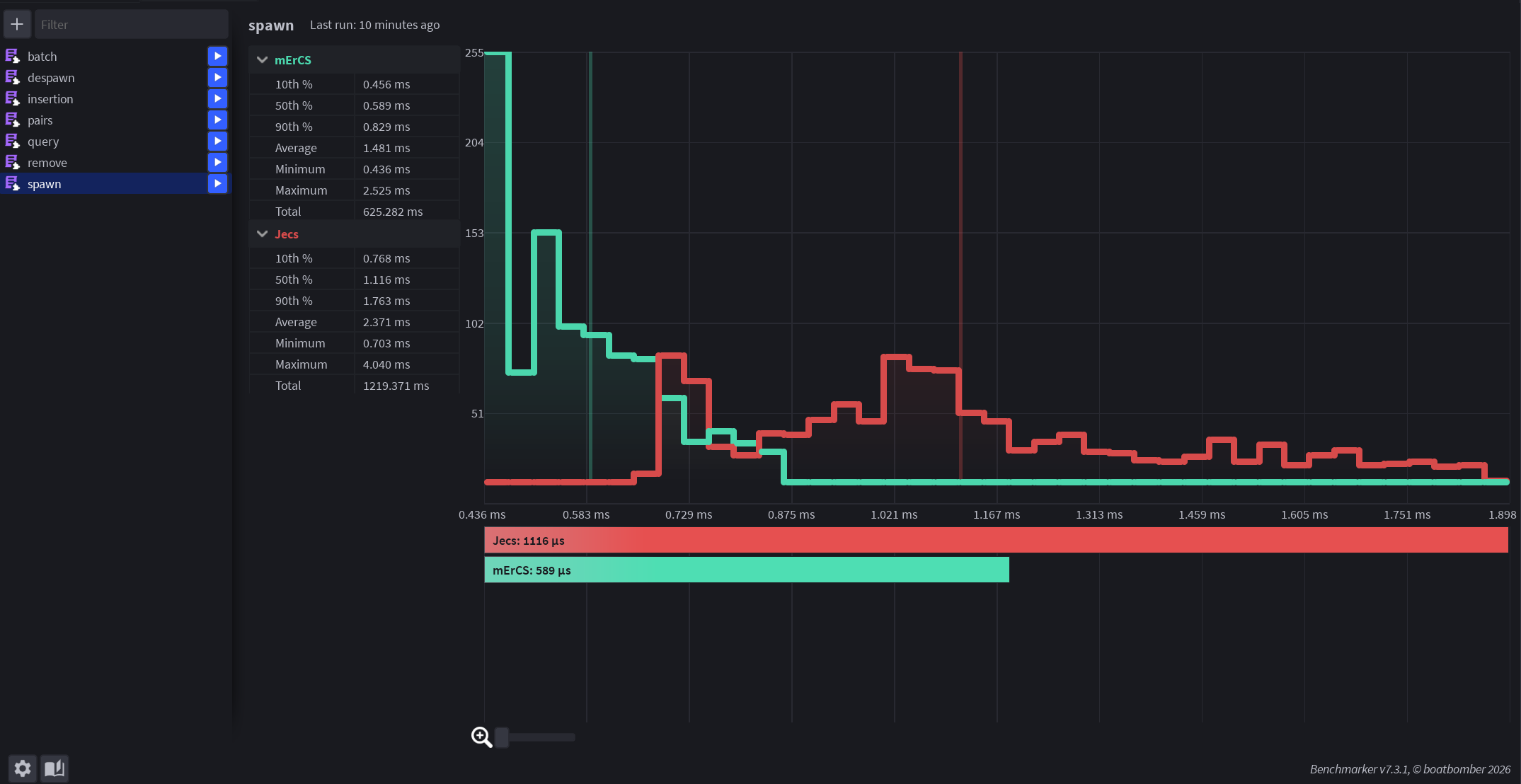
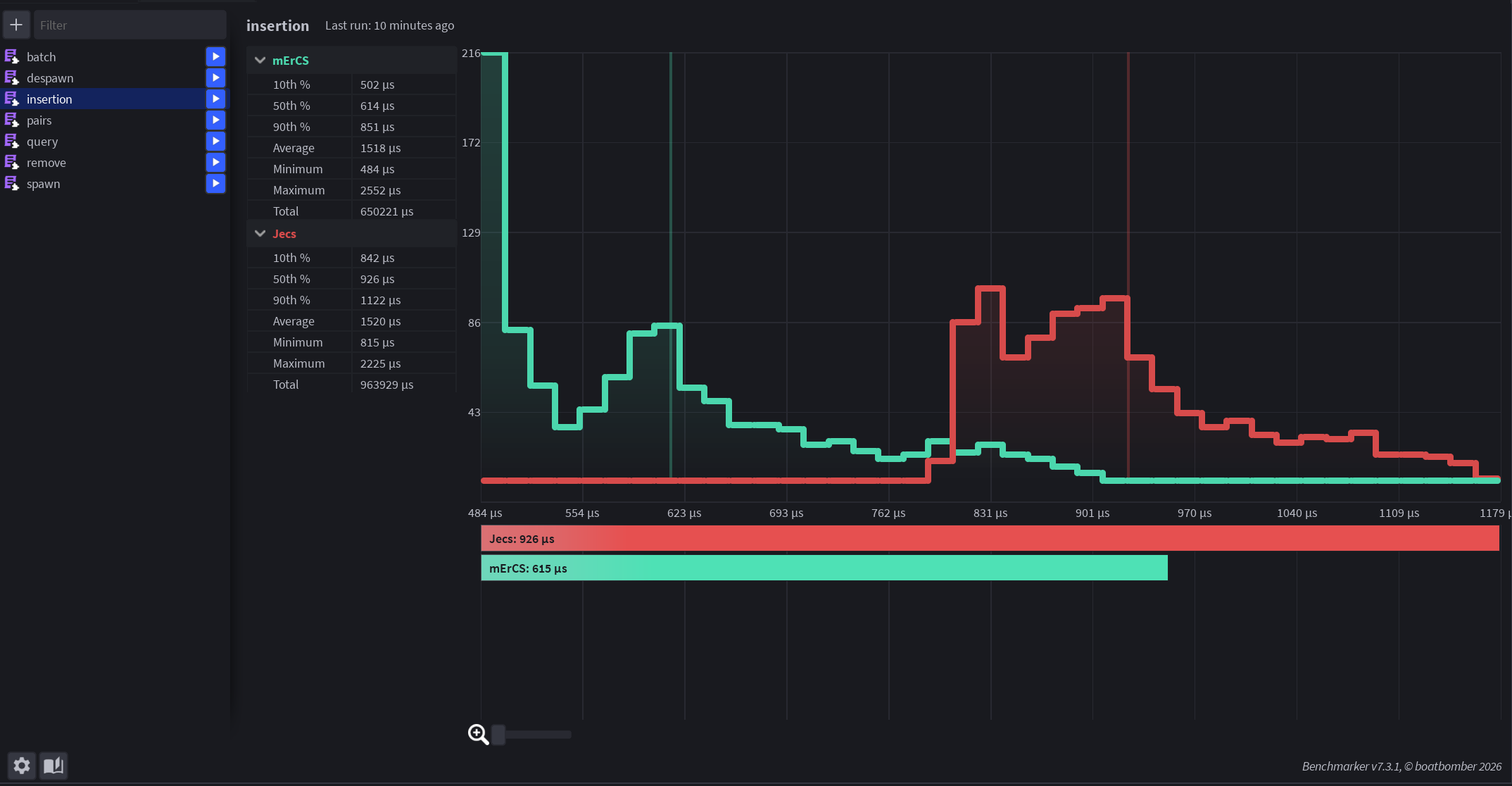
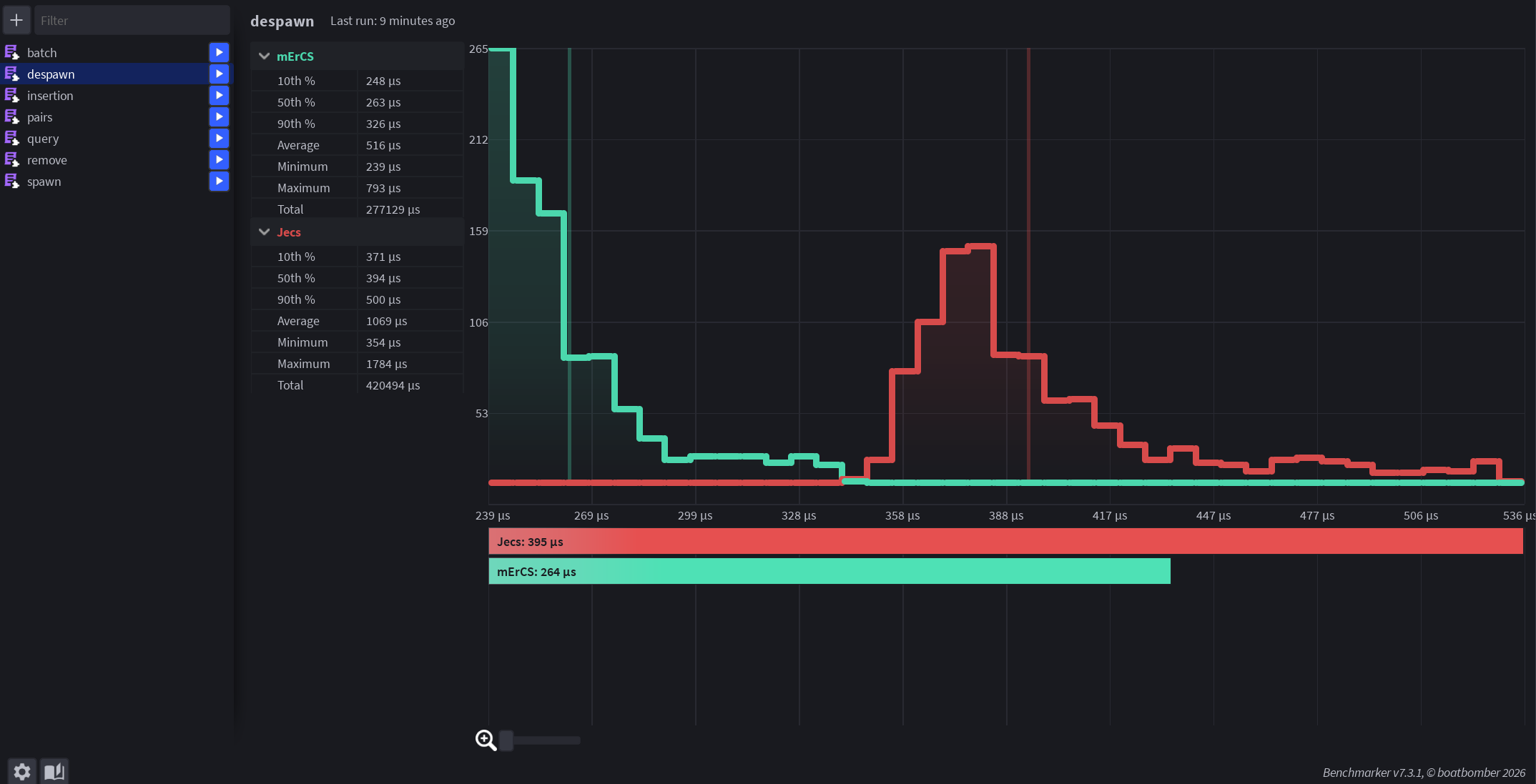
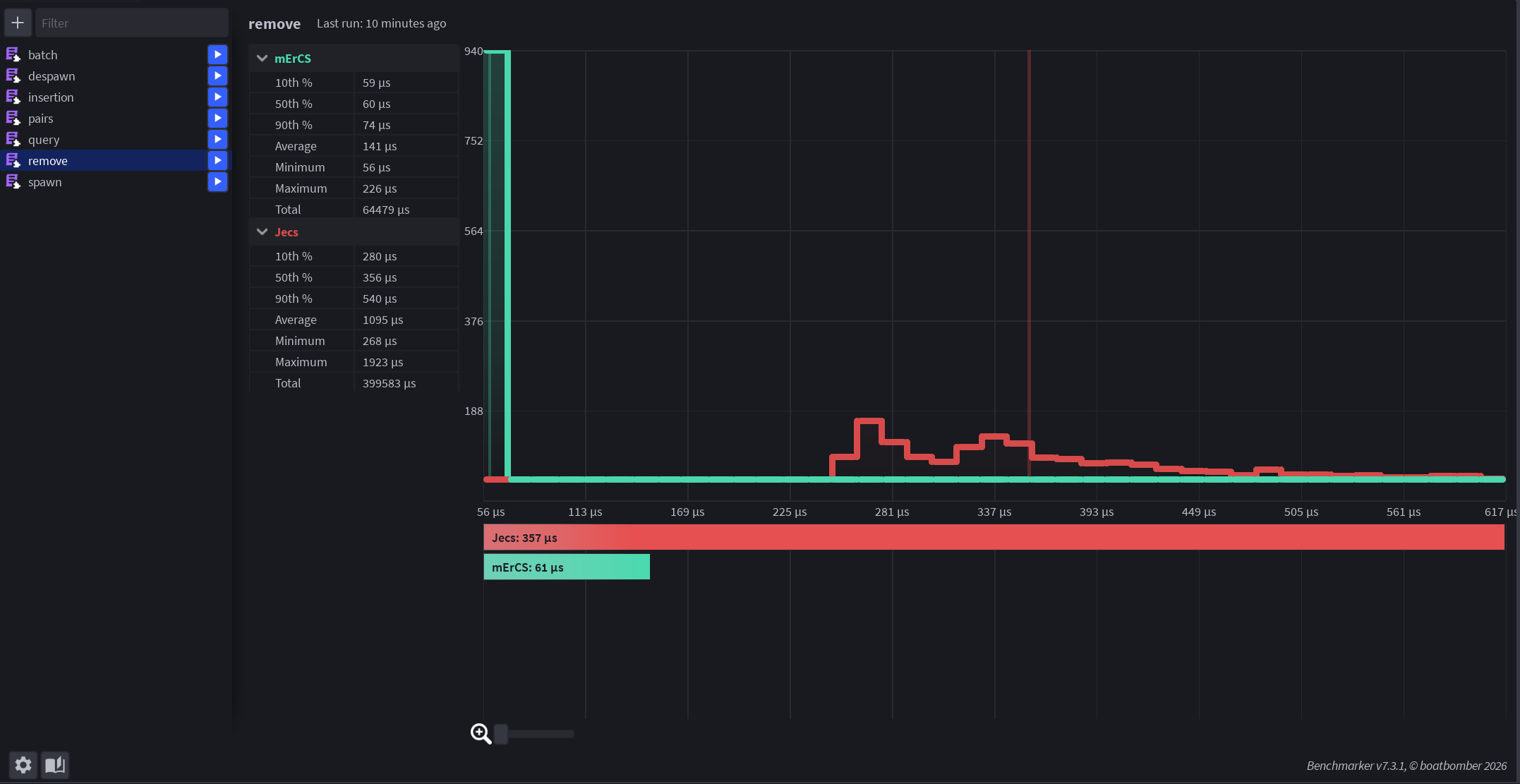
The files of bench/visual/ run in Roblox Studio with the Benchmarker plugin (v7.3.1): Edit
mode, native code (the library and jecs are --!native), 1000 calls of each function. The
table compares the medians (50th percentile); the "Average" of Benchmarker is the midpoint of
the minimum and the maximum, not the mean.
| File | What | jecs | mErCS | ratio |
|---|---|---|---|---|
spawn.bench.luau | 1000 entities with 4 components | 1.116 ms | 0.589 ms | 0.53× |
insertion.bench.luau | 8 components into 500 existing entities | 926 µs | 614 µs | 0.66× |
despawn.bench.luau | delete 1000 entities with 4 components and a tag | 394 µs | 263 µs | 0.67× |
remove.bench.luau | remove one of 5 components from 1000 entities | 356 µs | 60 µs | 0.17× |
pairs.bench.luau | 100 parents with 10 ChildOf children that also target a parent through a relation, then the parents are deleted | 7.971 ms | 1.762 ms | 0.22× |
batch.bench.luau | add and remove a tag on 1000 of 2000 entities: batch operations against a jecs collect-and-change loop | 496 µs | 49 µs | 0.10× |
query.bench.luau | 10 passes of a 4-component query over 4096 entities: for-in / query:each | 98 µs | 120 µs / 45 µs | 1.22× / 0.46× |
Where mErCS is still slower
- Interpreter: a for-in over dense data, adding a first component and
withoutby 5–13 % (eachis 30–40 % faster than the jecs loop);haswith 4 ids (1.2–1.3×); a for-in over a sparse match (1.5×: the values of a sparse component sit in the hash part of their page;eachis on par with jecs); adding pairs of one relation with many targets spread over the entities (1.4–1.8×: the presence words of each pair sit in a hash). - Native: the sparse for-in (1.5×),
withoutand the manual dense loop (1.1×). - Roblox Studio (Benchmarker, native): the for-in of
query.bench.luau(1.22×;query:eachtakes 0.46× of the jecs loop).
Migrating from jecs
-
Point the jecs require at this module (
local jecs = require(path.to.mErCS)) and change the jecs calls that do not exist here (the type checker points at them):jecs mErCS jecs.World.new()jecs.world()jecs.wjecs.Wildcardjecs.bulk_insert(world, e, ids, values)world:set(e, ids[i], values[i])for each idjecs.bulk_remove(world, e, ids)world:remove(e, id)for each idjecs.new(world)world:entity()jecs.new_w_id(world, id)world:entity(), thenworld:add(e, id)jecs.new_low_id(world)world:entity(): a low id is not faster herefor e, a in query:iter() do,local step = query:iter()for e, a in query do(orquery:each(fn))jecs.is_tag(world, id)not world:has(id, jecs.Component)(for a pair: neither element has it)jecs.entity_index_try_get(world.entity_index, e)world:contains(e); the ids ofe:world:ids(e)world:cleanup(),query:fini()delete the call: there is nothing to release jecs.ArchetypeCreate,jecs.ArchetypeDeletedelete: there are no archetypes jabby needs the adapter instead of the plain module.
Then run the game: the world API, pairs, wildcards, hooks, signals, cleanup policies,
Name,jecs.component()/jecs.tag()/jecs.meta()and theECS_*helpers keep their meaning. A debug world,ecs.world(true), raises errors for dead entities and ids on every change while you migrate. -
Rewrite what reads archetypes: loops over
query:archetypes()withcolumns/columns_mapbecomequery:each(fn)(orquery:spans()withworld:column(id)for the hottest loops); hooks that useoldarchetyperead the entity withworld:get/world:has. -
Remove most
:cached()calls: shared queries are cached already (see Coming from jecs). Replace the observer addon with signals, hooks orworld:trackwith the:added/:changed/:removedfilters. -
Replace "collect the matches, then change them" loops with batch operations (
query:add_all,set_all,remove_all,delete_all,count), and state flags stored as components with tags (Disabledhides entities from queries without removing anything). -
Code that depends on the iteration order of archetypes, or on the numbers of builtin ids after
Name(jecs.Restis 270 here), needs a look (see the differences above).